
Game Review: “Taito Milestones 2” (Nintendo Switch)
Hey! It’s Darius!… 2! Aaaaaannnd a bunch of other games that never made it to the good ol’ U.S. of A. Some may be familiar with The Legend of Kage or maybe an import or emulation enthusiast may have touched on some of these, but I imagine that most of the games on the Taito Milestones 2 collection will be played for the first time by the majority of us out there who decide to pick this one up. Is it worthy of your hard earned cash? Well, considering most of these titles would have been a quarter back in their day, and figuring how many times I would have popped a quarter into one of these machines… and inflation…
Each of the games included are just bare-bones ports of the arcade titles. You are given the ability to save most of the games with an “Interrupt Save Data” that takes you to where you saved when you boot up the title. Oddly, not all titles support that feature. I guess they were going for authenticity on some of the earlier titles which didn’t allow you to continue and you were just competing for scores on a single quarter, anyway. Crazy, I know, but in the early years, game developers didn’t have it all figured out yet. Regardless, you are pretty much getting an authentic arcade experience with each of these titles, and that’s it. It does include online rankings, so at least we can still compete for scores like we used to.
So, here’s a look at each one of the games included in this compilation:

Ben Bero Beh (1984): A very “Japanese” looking game, in which you are a fire hose wielding superhero trying to save the fair maiden from a fire in the building. It follows the Donkey Kong, Popeye, and Mario Bros. single-screen level action style. You can aim your fire hose up or down to get a better angle in order to extinguish the flames, or to interact with various obstacles, which was a cool touch. Music wise, you have your super repetitive arcade music bleep track playing the whole time. The floors can collapse below your feet, and the ceiling can fall in on your head. Plus, there is the constant threat that the fire will collapse in the whole building, so there is a mild sense of urgency in your play.
Unfortunately, this is one of the titles that does not allow for a save state, and with the ease of getting yourself killed, I only managed to make it like seven levels in. I did feel like a lot of deaths were “gotcha” moments, but at the same time, I kept trying to think of strategies to avoid them in the first place. And I did enjoy coming back to this one over and over in short bursts, but definitely wanted to have gotten further in my play time with it. I’ll probably keep checking in and see if I can get any further over time, but definitely one that was just meant to be played for a place on the high score screen. It is worth noting that I did see a couple of familiar faces pop-up in this game… and when the bad guy from Elevator Action walked out of a door… I went a little giddy! I love Elevator Action!

The Legend of Kage (1985): I remember this one looking so cool on the NES back in the day. You are a ninja who is out to save the princess who was just kidnapped, and you can JUMP like one of those ninjas in the movies! With both multi-directional shuriken and katana, you can take out the bad guys from wherever they may pop up, and you can deflect their projectiles as well! While you have the jump ability to practically leap over the massive trees, you can also climb them manually if you prefer the slow route, while still being able to attack. For 1985, this is probably the most “ninja” bad-ass you could have felt back in the day.
Sadly, there are only four levels: the woods, the sewers, the tower, and the dojo. Once you rescue the princess and jump to safety, they just kidnap her again, and you repeat the process. There is a brief “ending” sequence if you can complete it twice, and the scenery changes “slightly” from green trees to snowy trees. But after four times through, you will have seen all there is to see. The Legend of Kage has its share of sudden death by an enemy who just popped on the screen, and this is another one that did not work with the save state. So, sometimes I plowed through all the levels like a bad-ass, but other times, I didn’t even finish the first stage! Still, I had an absolute blast jumping all over the place, shooting Raiden wannabes from the sky, and finding ninja magic to unleash an absolute onslaught of death on massive hoards of enemy ninjas! Just don’t feel too bad if you feel like the “gotcha” deaths are frequent… You aren’t missing much, so just enjoy feeling like the ninja bad-ass you are!

Kiki Kai-Kai (1986): Does anyone remember Pocky & Rocky on the SNES back in the day? Kiki Kai-Kai is the arcade prequel that we never saw over here. It feels very much like one of my favorite Sega Master System games, The Ninja (aka Ninja Princess in the arcades), so I couldn’t help but wonder if there was any inspiration here. Basically, Kiki Kai-Kai plays out like other overhead action games of the time, like Commando, Ikari Warriors, or Time Soldiers. You are the warrior maiden who sets out to purify the Seven Gods of Fortune by either your purification rod, or by throwing purification scrolls. There are hidden power-ups that can kill all the enemies on the screen, or charge up your scroll shot. You must first find the key out in plain sight somewhere in the level that will unlock the room to the boss. Upon defeating the boss, you free one of the gods and move on to the next stage.
Kiki Kai-Kai does not let you abuse a save file, and another tough one to get too far in. I never was able to rescue more than two of the gods, but considering how many times I played The Ninja back in the day and never finishing it, it didn’t feel like unfamiliar territory. I enjoy going back to these and getting better and better, but I know that can set off some. Despite not finishing the game, Kiki Kai-Kai was probably my personal favorite on this compilation.

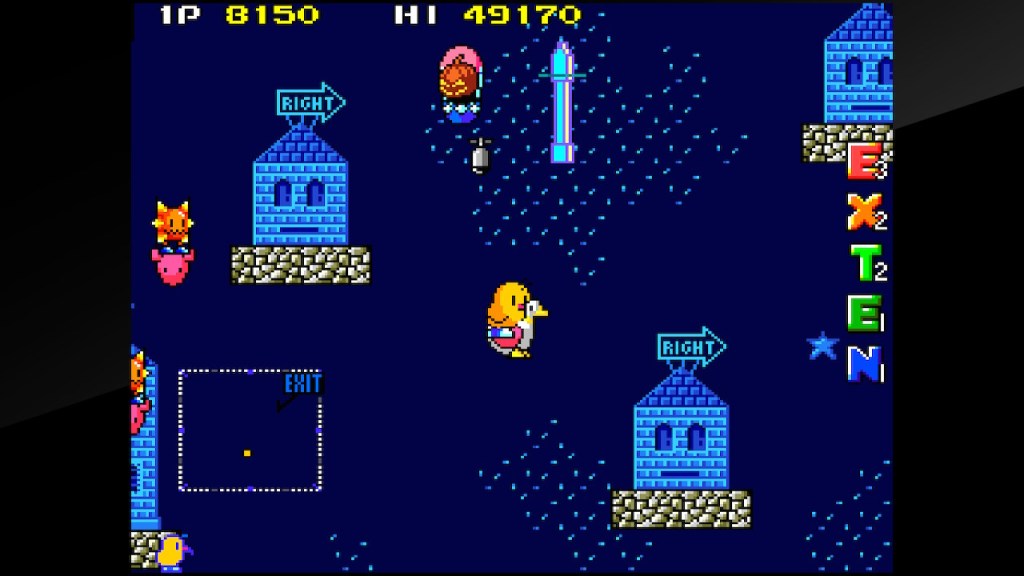
New Zealand Story (1988): The surprise inclusion here, New Zealand Story has you playing as a kiwi out to save his girlfriend Phee Phee from the bad guys. You can steal certain baddies rides, and use them to help you navigate each maze of danger full of water (yes, you can drown), spikes, and of course hidden doors full of enemies. If you take too long navigating any one of these maze-like levels, then the devil of time will chase you down and put an end to your feeble life.
While the controls do not feel bad, they are a little slow, and took a little adjustment for me to get used to. Using some of the rides help make the controls feel a bit zippier, so while it’s all by design, it does feel a bit maddening at times. Enemies can come from anywhere since doors just appear out of nowhere and bring out hoards of them all over the place, so expect to die a lot! At least from here on out, the save system seemed to work, and you can also continue from where you left off in the game with your unlimited quarters, so keep playing as long as you are having fun. Personally, I got stuck in a loop further into the game, where I guess once you die too many times on a level, you are eventually taken to Heaven. If you complete Heaven, then you are sent back to the level and have to do it all over from the beginning. Still, I had fun with New Zealand Story, and will be coming back to play it again.
Darius II (3 Screen Arcade Version, 1989): It’s time to put a hurt on those alien sea creatures from hell once again! The first thing you’ll notice about Darius II is the screen is extended, unlike other games on this compilation. That’s because the original arcade was one of those that pieced together multi-monitor cabinets that used the massive play-field as part of the draw of the game. If you played Darius before, then Darius II is not going to feel unfamiliar. It’s space shooting goodness that relies on multiple upon multiple of quarters to either memorize patterns and protect your power-ups (which you lose upon death), or just trudge through hitting what you can and keep on continuing until the end. There are multiple paths to choose from during your travels, so think of like the OutRun branching path system in a shooter, and that’s what you have here. It gives good reason for multiple playthroughs, but also makes it more challenging to memorize specific patterns venturing out into the great unknown!
I know good and well that there is a collection of gamers out there who live for these kinds of games. Getting that 1cc (1 credit completion) is a thing for some, but I imagine most would find the difficulty in Darius II to be too frustrating to have invested all of their coinage into this one. Bosses take a lot of hits, and since you play the majority of the game with the bare minimum of power-ups (unless you “git gud!”), then you know the process. Insert quarter, shoot bad guy as fast as you can until your invincibility wears off, try and dodge what you can and land a few more hits until you are inevitably killed because you were meant to suck at this game, and then eventually reach game over where you can insert a quarter and keep pushing forward. Classic “Quarter Cruncher!” Personally, I kind of fall in between the shooter fanatic and the casual gamer, though, so I enjoy this type of game a lot, but I imagine most don’t have the patience for learning the patterns to actually be able to hold onto a power-up for even a whole level! Ahhh, the good ol’ days!

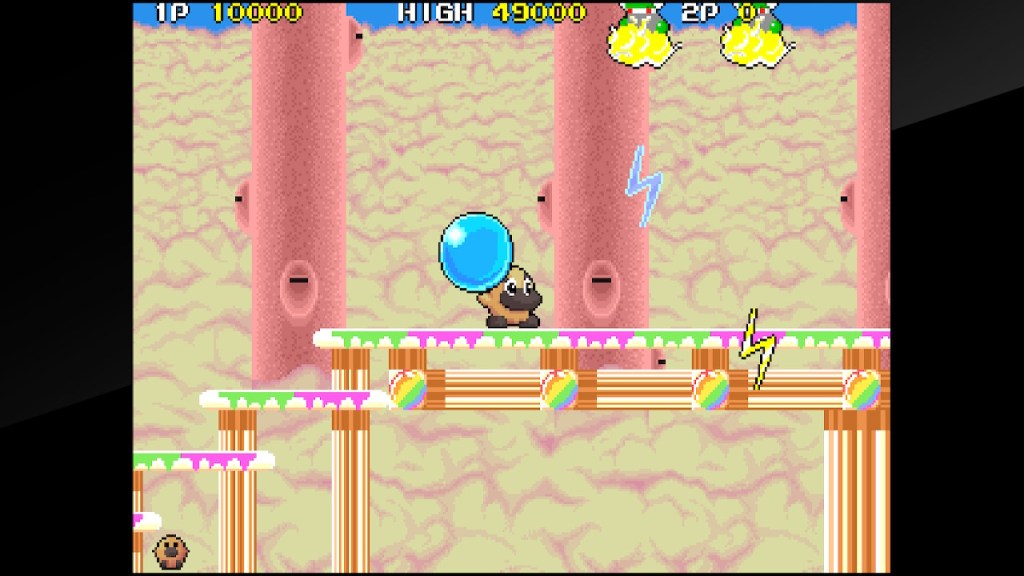
Liquid Kids (aka Mizubaku Adventure, 1990): OK, so I’m kind of surprised that Liquid Kids isn’t a part of the Bubble Bobble family of games. You play as a badger looking creature that carries around water bubbles that you can use to stun bad guys, and then completely knock them out of the way, just like Bubble Bobble, Parasol Stars, or Snow Bros. and similar games, but in more of a lengthy level, than a single screen. Liquid Kids is cutesy, and not too terribly difficult compared to others included in Taito Milestones 2, so probably the most accessible game on the list. My wife played through the majority of the game with me, however, near the end, it gets a bit punishing, and became too frustrating for her to finish, so I completed this one single-player. The bosses are closer to the classic Bubble Bobble single-screen style, and they are not too tough if you take time to learn their patterns.
While I enjoyed Liquid Kids a great deal, I don’t see myself coming back to this one much now that I’ve completed it. The slowness of your character makes it sort of a slog, and I just feel like I’d rather play Bubble Bobble instead if I’m being forced to go so slow. Still, I was happy to play through it once, and wouldn’t be opposed if someone asked me to play through it with them or something.
Gun Frontier (1990): The lone vertical scrolling shooter on this disk… and beautiful! Gun Frontier is one that was new to me, and it’s easily one of my favorite looking games included in Taito Milestones 2! Gun Frontier does little things that make it feel more “real,” you might say. It was 1990 and all, but one level has you flying over wheat fields that you can see blowing in the winds, and as you knock down enemy buildings, they sort of “crumble” in a way that feels different than other games at the time. And crashing a movie theater to see the movie screen playing the film still was a neat touch that makes this one fun to play! ‘Member movie theaters? I ‘member!
While the gameplay isn’t remarkably original, you can pick up charges to build up a bomb attack, at least. The atmosphere in Gun Frontier is the real treat though, and even when you power-down from dying over and over and over because of the difficulty, I still found myself wanting to make it through to the next surprise. Gun Frontier would have been the one to absolutely eat my quarters in ye’ olden arcades!

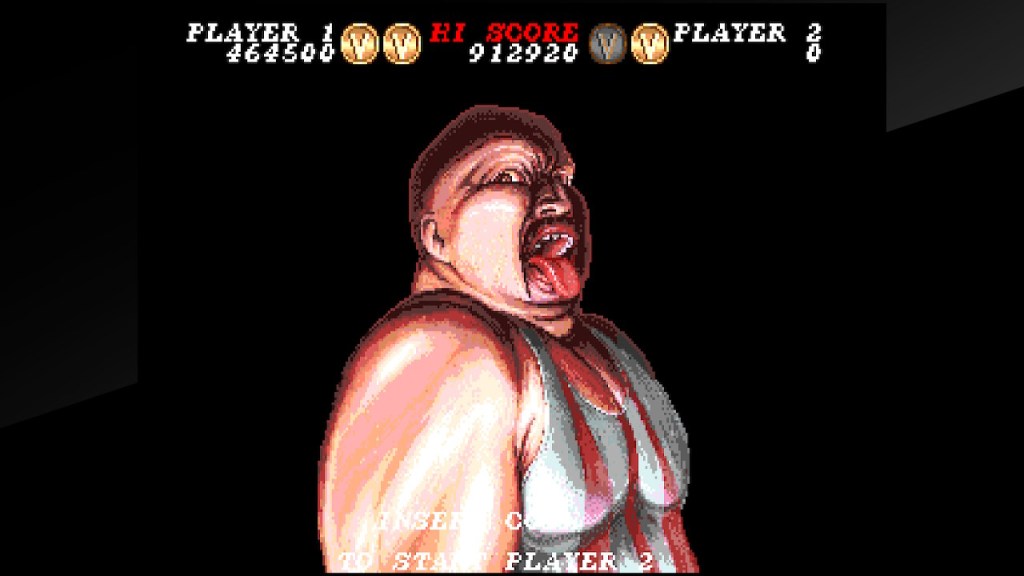
Solitary Fighter (1991): Sort of a mix between something like Double Dragon and Street Fighter, Solitary Fighter feels more like a wrestling game than a traditional fighter like Street Fighter II. So, this is another one that I had never heard of, and now that I’ve given it a few rounds, I can understand why.
As with most other fighting games, you choose your fighter, and proceed to attempt to put a whoop-up on all of your opponents until you have knocked them all silly. The level you play on actually changes from stage to stage, so one character you may face off against in classic Street Fighter fashion with no moving into or out of the foreground. Other levels give you free range so your fight plays out more like a brawler boss fight in Streets of Rage or something. There are boxes in some levels that you can use to break open or use on your opponents. In other levels, an onlooker in the stands may decide to get their hands dirty and join in the fight either against you or your opponent. The graphics look pretty good for their time, but the gameplay…
…Ugh! What a chore! It lacks all sort of refinement that we have come to expect in our fighting games since Street Fighter II! It’s more “button mashy” like your standard brawler of the time, but it doesn’t even do that very well. Attacks can be slow, and not all characters feel very balanced. I get that technically this game predated Street Fighter II by two years (as Violence Fight… Think how Street Fighter II updated itself as SF2: Champion Edition), and I can appreciate that it’s here in the collection, but after being spoiled on what fighting games later became, it’s definitely one of the hardest ones to get into today. Maybe if they had made a sequel, it could have been a better experience. I mean, Street Fighter 1 sucked, too!
Metal Black (1991): Ahhhh! Now here is one that I remember from the import scene back on the Sega Saturn. Metal Black is a horizontal shooter, and while it is given the project name as “Project Gun Frontier 2,” it really doesn’t have much in common with Gun Frontier (previously discussed on this compilation). I guess Gun Frontier was popular in Japan or something to sell this one as Gun Frontier 2… You know? Gun Frontier was pretty, though, so maybe there was a following? That I don’t know, but what I do know is, is that Metal Black is another classic example of the shooter genre, that I’m sure shooter fans will be happy to have a little more readily available on this Taito Milestones 2 collection.
Metal Black looks pretty, and plays well, and has a sweet soundtrack. It’s fairly difficult for anyone less than a pro, but you can get multi-colored power-ups all over the place that can build up your beam meter. Depending on how full you charge your beam level, you can unleash a barrage of hyper-laser blasts all over the screen, which is very satisfying. With unlimited credits, Metal Black is completable for sure, but for those shooter champions out there, it’s still got that crazy difficulty intact. I wouldn’t say that Metal Black is the best shooter I’ve ever played, but it’s far, far from the worst. It’s nice to have, but it’s also really only for those who are into this kind of game or don’t mind getting pulverized on your way to completion.

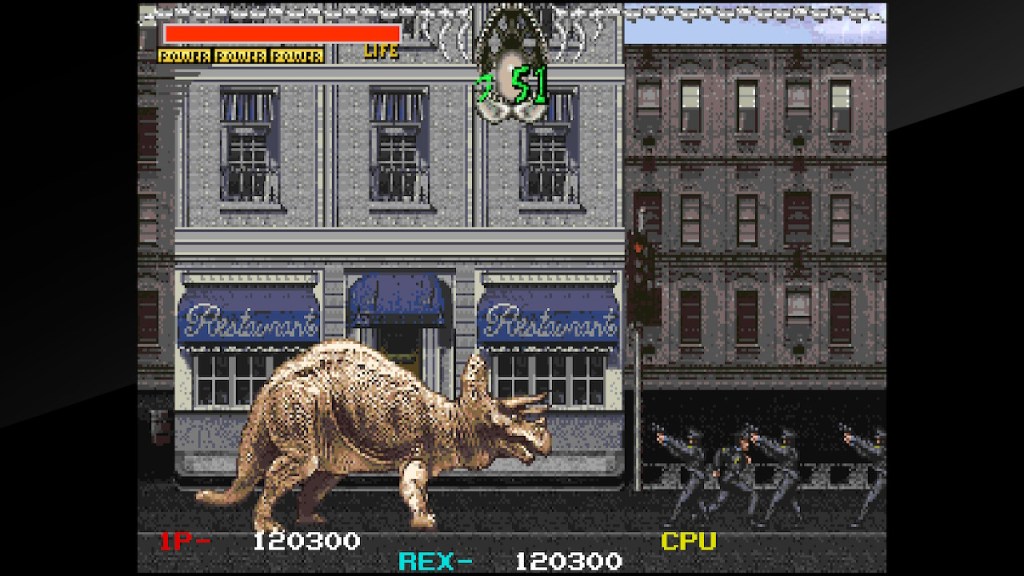
Dino Rex (1992): What’s this? A one-on-one dinosaur fighting game that came out BEFORE Primal Rage? And, it looks pretty freakin’ sweet on top of that! Dino Rex is a crazy discovery, considering how much I LOVED Primal Rage, and DESPERATELY wanted Primal Rage 2 to be released… but finding what may have been some sort of inspiration here? Oh, man! I couldn’t wait to play this one!
And then I played Dino Rex… and found that it’s just too broken to be enjoyable. It starts out as simply, “clunky.” The controls don’t feel the tightest, and the moves are few to be had and need to be extremely precise to hit, but you can manage to plow through a few opponents by just hoping for the best. And then, the computer will automatically start to counter your every move only to end you with an ear numbing dinosaur cry. I mean it looks so good, and actually sounds like what I’d expect dinosaurs to sound like, and maybe it was some inspiration for Primal Rage at least… If not, well… Primal Rage was probably better off without it! I do like the look a lot, though, and the bonus level was kind of a cool action stage, so I’m at least still happy to have experienced Dino Rex at least once!
So would I have spent much to play these in arcades of yester-year? Yeah, I imagine I would have spent at least $20 on all of these combined… but for the $40 asking price for Taito Milestones 2? That may be a stretch, unless you happened to catch me on a day where I had a pocket FULL of quarters and the urge to actually see the end of some of these near impossible games hit me… But hey, that’s the joy of not having to carry quarters now! Right?
I did play through the majority of these for this review, but some, just like in the day, you get the gist of after a few plays and can’t be convinced to keep dumping your hard earned allowance into a very brief “play” of some of these. I probably would have spent $40 on quarters in the amount of time I spent on these, but definitely not evenly.
What about today’s play for dollars? For shooter enthusiasts who want to own some key games in the genre that never made it out over here previously, then you can’t even get one of the imports at this price, so seems like it’d be worth it for them for sure. For the rest of us, unless you are trying to just cram as many old school games on your Switch as you can like I am, I feel like $40 is a bit much for Taito Milestones 2. Especially if you don’t have the first one already. Still, I’d pick it up on a sale day or something if you are into these kinds of collections. How deep a sale really just depends on how much you enjoy brutal shooters and action games of the past! Just forget the fighting games are even on here… Sorry fighting game fans!
Disclosure: A copy of Taito Milestones 2 was provided by ININ Games to The Splintering for the purpose of this review.
Thanks for reading!
Please consider following The Splintering on social media or bookmarking the site for more independent entertainment news, views, and commentary!

The Splintering’s TeePublic store has items for all budgets, great and small! If you like what we do & want to help keep our site 100% free of paid ads, go here!
 The Splintering