
Retro Game Review: “Raging Fighter” (Nintendo Game Boy, Monochrome May Special)

Welcome back to Monochrome May, The Splintering’s month-long celebration of everything faded and old. Sorta.
Today we’re going to pick apart Raging Fighter, a one-on-one fighting game for the Nintendo Game Boy published in 1993 by Konami.
As many who lived through the early 90s fighting game craze might recall, fighting games could often be lumped into two categories: the ones that wanted to be Street Fighter II, and the ones that wanted to be Mortal Kombat. So which one is Raging Fighter?
Street Fighter. Easy.

Raging Fighter (aka Outburst in Japan) features a roster of seven playable characters: Tao, Miyabi, Bulk, Aska, Vandal, and Ruoh and Shades (who are basically minor redesigns of the same character à la Ken and Ryu). Each fighter has their own set of punches, kicks and unique special attacks, which are executed much like other fighting games at the time, but limited to the two buttons on the Game Boy hardware. As you may expect, the special moves are very tough to pull off, as the reaction time on the Game Boy is difficult to gauge for fast-paced, twitch-style gameplay. The select and start buttons oddly serve zero purpose – they don’t even pause the game.
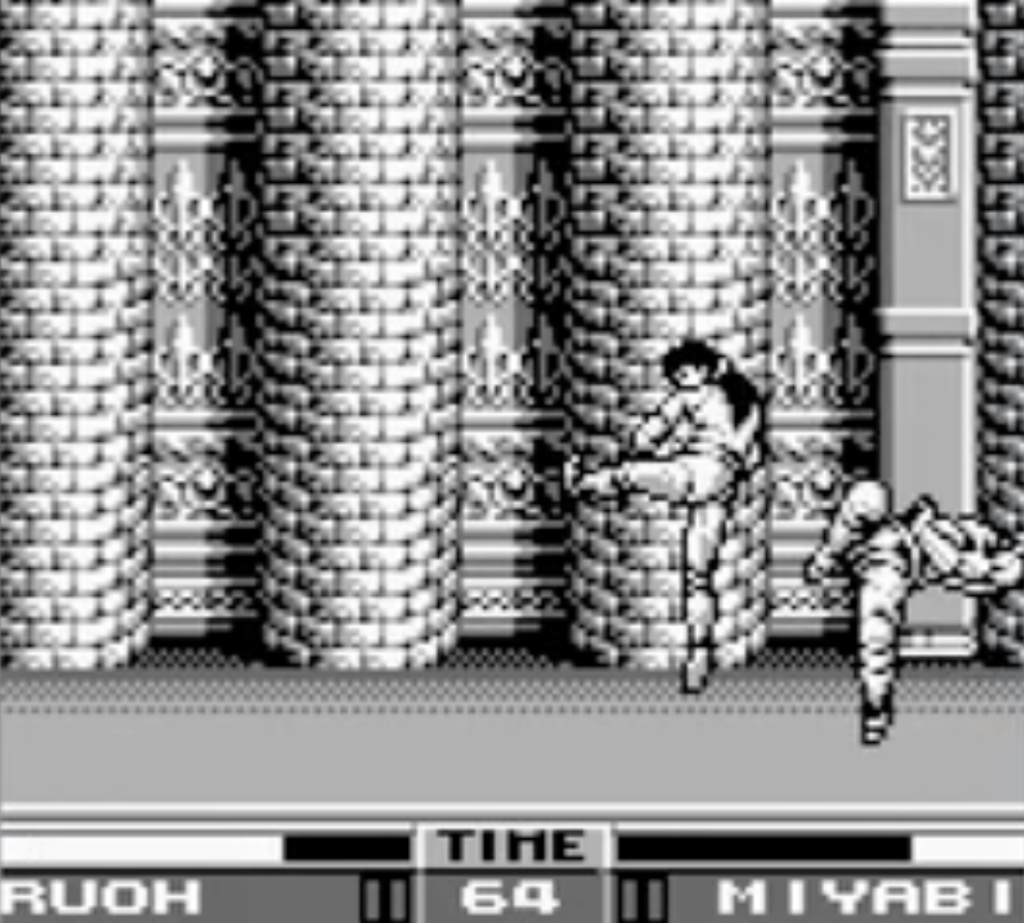
You can pick from four difficulty levels in four separate game modes: Story, Tournament, Practice and Versus.
The poorly named Story Mode doesn’t really offer anything in terms of “plot.” From the game itself, I couldn’t tell you anything about who the characters are or why they are fighting each other. Story mode is actually much more like an endurance/elimination mode, where you select a set of three characters and try to survive a contagion of single round fights, all the while your health does not return between rounds.
Tournament puts you in a one-on-one fight against every fighter, including the final battle against Raging Fighter’s ultimate boss: Guilga. If you were expecting an interesting fight out of him (?), prepare to be disappointed. Even though he looks like Street Fighter II’s Vega on the versus screen, the fight is nothing more than a mirror match, as Guilga takes on the form of your selected fighter. It’s a pretty lazy climax, even for a handheld game in 1993. Once you defeat Guilga, there’s isn’t much of an ending, either; just a quick character demo and credits. Nothing that you would care to reach a second time if you ever saw it, which is pretty tough, even on the easiest difficulty setting.

I give Raging Fighter credit for having multiple game modes, which several console fighters of the time didn’t even have. However, when the fighting mechanics themselves aren’t quite satisfying enough to keep you keenly interested, so little things such as a unique boss fight or giving the characters their own unique ending could have gone a long way.
The Versus mode does allow you to link two Game Boy systems together for head-to-head play, which is where most fighting games shine, but you need two systems, a link cable, and two copies of the game to do it. I’m guessing there weren’t very many Raging Fighter versus matches played back in the game’s heyday.
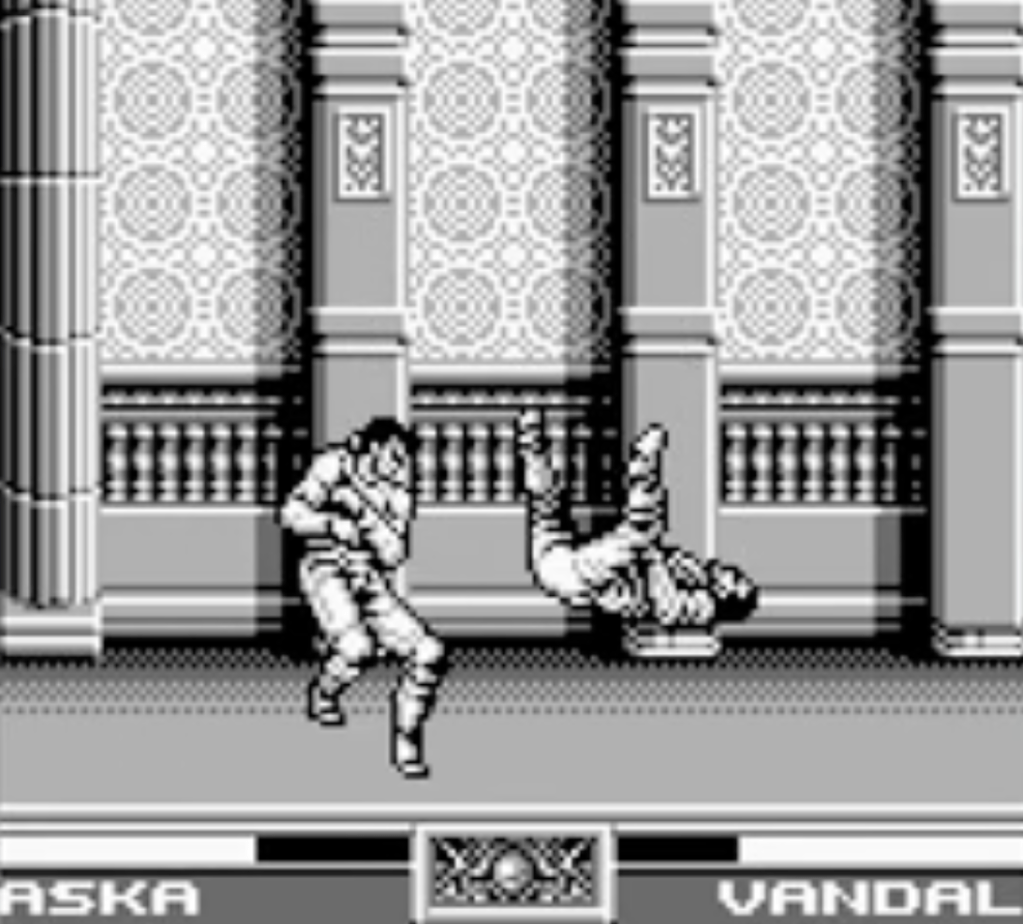
Aesthetically, Raging Fighter was a fairly impressive Game Boy title for 1993. The character sprites are rather large, and they are mostly white and light grey with heavy outlines, so it’s easier to keep them distinct from the background on the Game Boy’s monochrome green screen. Those stage backdrops look okay- Asian flare tower with columns and detailed backgrounds.
On the sound side, there are also some decent Konami-esque tunes to set the mood, but nothing I’d call remarkable. No booming voices to speak of though, such as “Hadouken!” or “Get over here!”, not that they were expected given the hardware limitations.
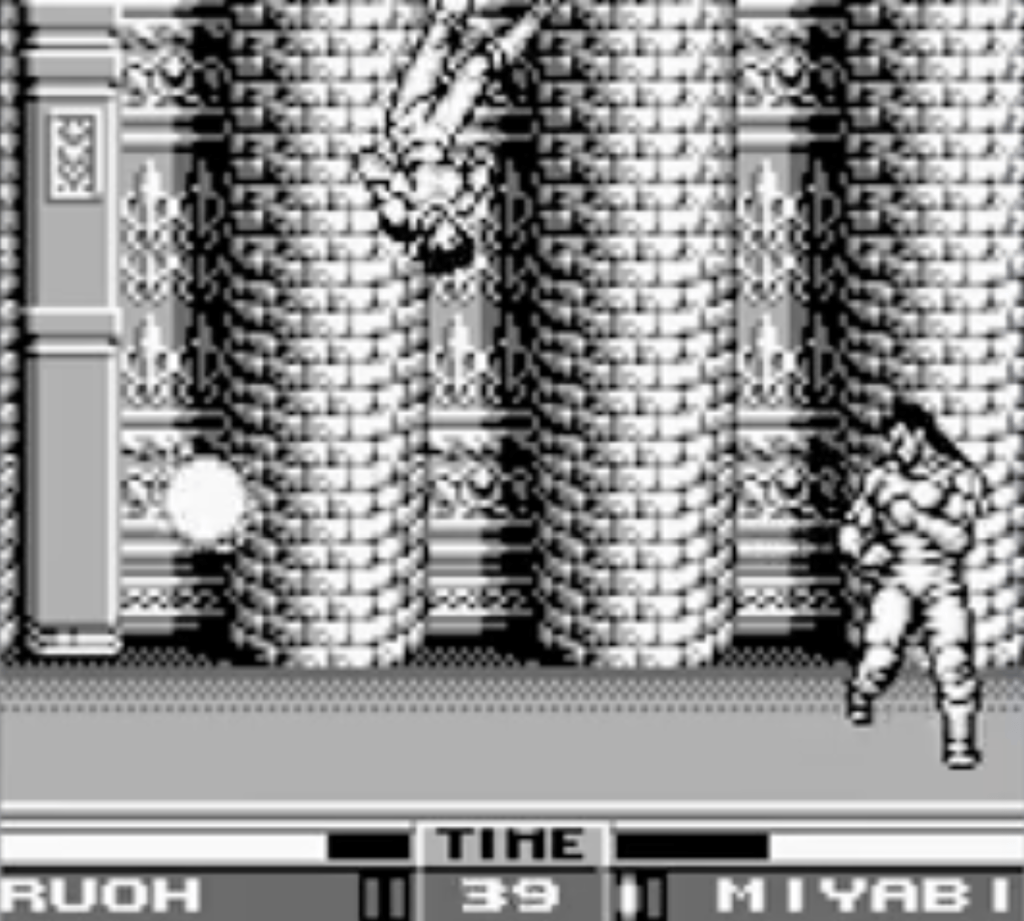
In 1993, I’d imagine that the creators of Raging Fighter were rather proud of how far they pushed Nintendo’s Game Boy hardware to actually deliver a decent handheld fighting experience. If you were looking for a Street Fighter-like to take on the go, Raging Fighter was a good bet in 1993, especially considering the competition coming from the Tiger LCD handhelds.
Would you pick up Raging Fighter now for any reason other than nostalgia? Almost certainly not. I’m willing to bet that there are several people out there who have some great memories of it from Christmas morning or Summer vacation. While I’d never rank it highly as either a fighting game or a Game Boy title, if you were to tell me that Raging Fighter was one of your personal favorites from the early 90s, I kinda get it.
Thanks for reading!
To check out more of The Splintering’s Monochrome May content, go here. Please consider following The Splintering on social media or bookmarking the site for more independent entertainment news, views, and commentary!

The Splintering’s TeesPublic store has items for all budgets, great and small! If you like what we do & want to help keep our site 100% free of paid ads, go here!
 The Splintering